
Serverless Hosting vs VPS Economics: Making the Right Business Choice
Choosing the right infrastructure can make or break your project’s budget. In 2026, the debate between Serverless Hosting vs VPS Economics has become central for businesses looking to scale without overspending. Both models offer distinct advantages, but the best choice depends entirely on your traffic patterns and technical resources.
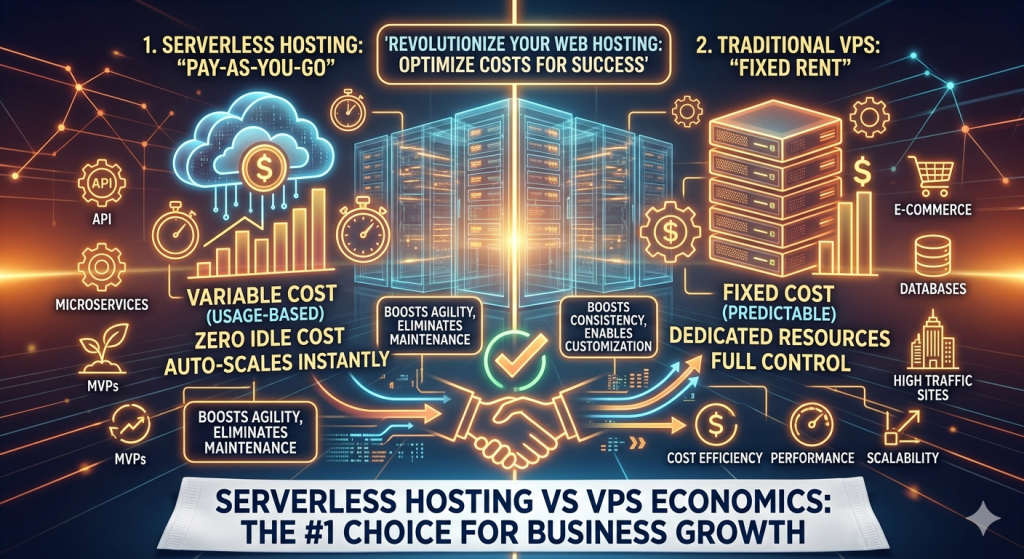
1. Serverless Hosting: The “Pay-as-You-Go” Model
Serverless hosting (like AWS Lambda or Vercel) abstracts the server management away. You only pay for the exact resources your code consumes while it’s running.
- Pros: Incredible scalability, zero maintenance, and cost-effective for unpredictable or low-traffic sites.
- Cons: “Cold starts” can cause slight delays, and costs can skyrocket if your code is inefficient or traffic is consistently high.
2. Traditional VPS: The “Fixed-Rent” Model
A Virtual Private Server (VPS) gives you a dedicated slice of a physical server with fixed resources (CPU, RAM, Storage).
- Pros: Total control over the environment, predictable monthly billing, and better performance for sustained, high-traffic applications.
- Cons: You pay for the resources even when they are idle, and scaling requires manual upgrades or complex load balancers.
3. Economic Comparison: Which Fits Your Needs?
| Feature | Serverless Hosting | Traditional VPS |
| Cost Structure | Variable (Usage-based) | Fixed (Monthly/Yearly) |
| Scalability | Instant & Automatic | Manual or Horizontal |
| Maintenance | None (Managed by Provider) | High (OS/Security Updates) |
| Best For | APIs, Microservices, MVPs | Large E-commerce, Databases |
Quick Summary: The Final Verdict
- Choose Serverless if you are launching a new app with fluctuating traffic or want to minimize DevOps work.
- Choose VPS if you have consistent, high-volume traffic and need deep customization of your server environment.